A 160-year-old paradox explains why AI will create more lawyers and accountants—not fewer, top economist says
Apollo chief economist Torsten Slok thinks AI doomers may be proven wrong. Just swap in "people" for "coal" in Jevons Paradox.

In 1865, English economist William Stanley Jevons observed that the invention of the Watt steam engine — which improved the efficiency of the coal-fired steam engine — made coal a more effective energy source. Jevons called it “a confusion of ideas” to assume the efficiency born from this invention would reduce coal consumption. That efficiency actually dramatically increased consumption even as the total amount of coal required for a particular task fell. There’s now a term for this seemingly contradictory idea: the Jevons paradox.
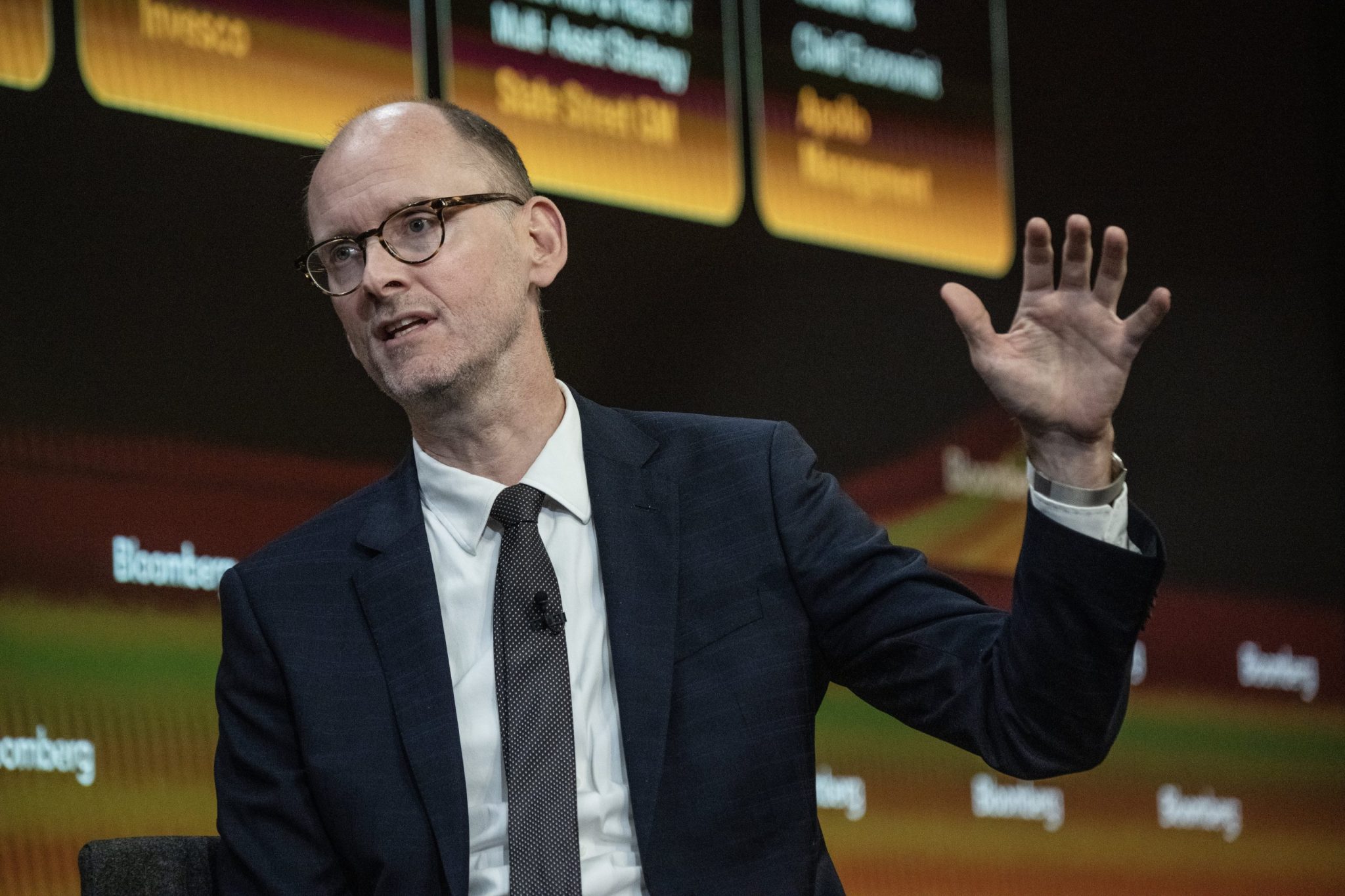
In a note on Tuesday, Apollo Global Management’s influential chief economist Torsten Slok applied the Jevons paradox to the AI age. In this scenario, labor is playing the role of coal, meaning as AI adoption increases, the technology will beget more jobs, not fewer. Slok calls this the Jevons employment effect. As the cost of professional work falls as AI makes tasks more efficient, the market for those tasks will actually expand. The total number of firms and workers in those fields—from law to accounting to consulting—will grow.
“When steam engines made coal more efficient, Britain didn’t burn less coal, it burned more,” Slok wrote in a note. “The same pattern is happening for cheaper legal services, consulting services and financial services.”
Slok’s assertion flies in the face of Silicon Valley’s conventional wisdom for the age of AI. More and more leaders are predicting AI will replace large swaths of the white-collar workforce as AI models become more sophisticated, making work more efficient. A recent Anthropic study found that AI is already capable of automating tasks associated with a handful of white-collar jobs, including management, law, and accounting.
The problem is that the future, to paraphrase a common saying, is like a foreign country. The Jevons paradox works when a cheaper input unlocks new demand that didn’t previously exist. Steam engines didn’t just make existing coal uses more efficient, they opened entirely new frontiers of industrial production that weren’t possible before. The key question for the AI era is whether cheaper legal memos, financial models, and consulting decks will similarly unlock dormant, unmet demand at scale—or whether most of that demand was already being served, and AI is simply doing the same work with fewer people.
The history of automation offers a more ambiguous record than the Jevons framing suggests. ATMs didn’t expand bank teller employment in the long run. Accounting software gutted bookkeeping jobs even as the broader accounting industry grew — the growth accrued to a smaller number of higher-skilled CPAs, not to the entry-level workforce displaced by QuickBooks. The Jevons Paradox may hold at the industry level while producing profound disruption at the worker level; we just don’t know yet. A close look at youth unemployment dynamics both supports, and undermines Slok’s central point.
The Gen Z hiring nightmare
Contrary to the buzzing discourse about a looming AI “jobpocalypse,” youth unemployment has actually been on the decline. After steadily increasing starting in 2023, the unemployment rate for 20- to 24-year-olds, those around college age, rose to a high of 9.2% in September. That rate has fallen since then, reaching a low of 5.6% in March.
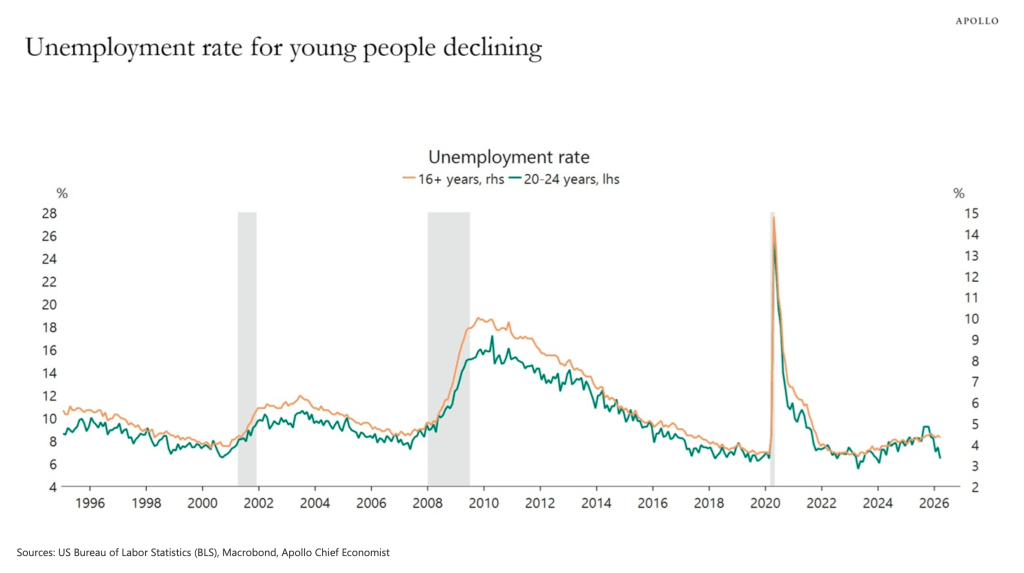
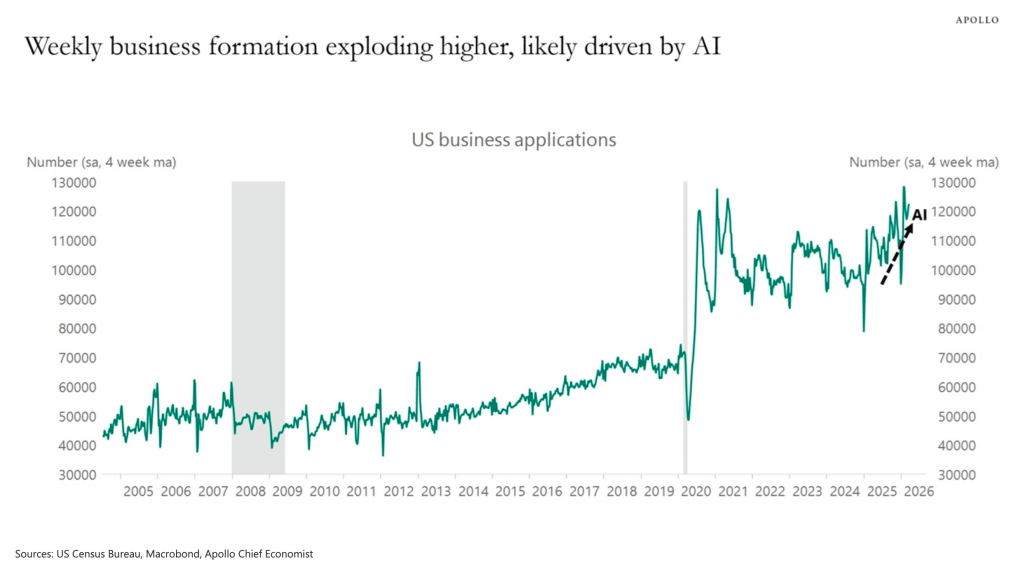
Slok attributes this trend to the recent college graduates launching startups, those hungry tech-oriented 20-somethings starting companies from their bedroom. The economist said these startups now compete with established firms on certain tasks. Those scrappy but hungry fresh grads are contributing to a boom in the economy. The number of new businesses created every week is at the highest level in U.S. history, according to the U.S. Census Bureau.
Slok’s own data point cuts both ways. Yes, youth unemployment has fallen and new business formation is at historic highs. But Slok attributes this to young people starting companies, not to a boom in entry-level associate hiring at law firms or Big Four accounting shops. That’s actually a story about entrepreneurship reshaping labor market structure—not Jevons-style expansion of traditional professional employment.
In 2025, the industries most vulnerable to AI automation actually saw the most job growth, according to a December 2025 Vanguard report, finding that instead of replacing workers, the technology is making them more productive.
“The approximately 100 occupations most exposed to AI automation are actually outperforming the rest of the labor market in terms of job growth and real wage increases,” the Vanguard report said. “This suggests that current AI systems are generally enhancing worker productivity and shifting workers’ tasks toward higher-value activities.”
To be sure, the outlook for Gen Z isn’t so rosy for those looking for in the white-collar work. The unemployment rate for recent college grads is above the rate for all workers, according to the Federal Reserve Bank of New York, a trend that has remained consistent since the COVID pandemic. As a result, many recent grads are rethinking the climb up the corporate ladder, with a majority considering entrepreneurship, gig work, freelance, or the trades.
The data gets a bit darker when you look beneath the surface. Underemployment is surging, with the New York Fed finding the underemployment rate for recent college graduates hit 42.5% in Q4 2025—its highest level since 2020. Also, The New York Fed finds recent grad unemployment elevated relative to the broader workforce, at 5.6–5.7% at the end of 2025, compared to an overall adult unemployment rate of just 4.2%.
College graduates also make up a record share of the unemployed, per the Dallas Fed. Bachelor’s degree holders now represent a full quarter of all unemployed Americans, a historic high, while high school graduates are finding jobs faster than college-educated workers, which is unprecedented.
The AI-Specific Signal
The Dallas Fed published a study in January 2026 finding that workers ages 22–25 in the most AI-exposed occupations have experienced a 13% decline in employment since 2022, per Stanford research, a trend driven by young workers failing to enter those jobs in the first place. The research reveals that AI isn’t firing young people, instead quietly closing the door on entry-level hiring. The Dallas Fed notes the aggregate unemployment impact is still small (about 0.1 percentage points).
But there’s a growing number of business leaders who are pushing back on the assertion that AI will replace workers. Nvidia CEO Jensen Huang has said the technology will make for more jobs, not fewer. He thinks his company will have more AI agents—and more workers in the future. Salesforce CEO Marc Benioff just put that idea to practice, saying he’s hiring 1,000 more entry-level workers to build the company’s AI systems. In February, IBM announced it was tripling its hiring of entry-level workers.
The Vanguard finding is encouraging, and Salesforce’s entry-level hiring push is a real signal worth watching. But it would be premature to treat today’s labor market as evidence that the Jevons effect is already winning. It’s possible that AI will expand some markets while contracting others, and the distributional question, who captures the gains, matters as much as the aggregate employment number. A world with more lawyers but fewer law firm associates, more financial analysis but fewer junior analysts, is not obviously a victory for the workers most at risk.
Slok may ultimately be right that cheaper inputs don’t shrink industries. But they do tend to restructure them, and for the workers caught in the restructuring, the paradox offers cold comfort.
This story was originally featured on Fortune.com
Share
What's Your Reaction?
 Like
0
Like
0
 Dislike
0
Dislike
0
 Love
0
Love
0
 Funny
0
Funny
0
 Angry
0
Angry
0
 Sad
0
Sad
0
 Wow
0
Wow
0