
Trend Exhaustion MT4 Indicator
The Trend Exhaustion MT4 Indicator was designed to address that exact issue. It helps traders spot when buying or selling pressure is stretched and a pause or reversal is likely. Instead of reacting late, traders can prepare early. Before getting into the details, it helps to understand what this indicator really measures and how it […]

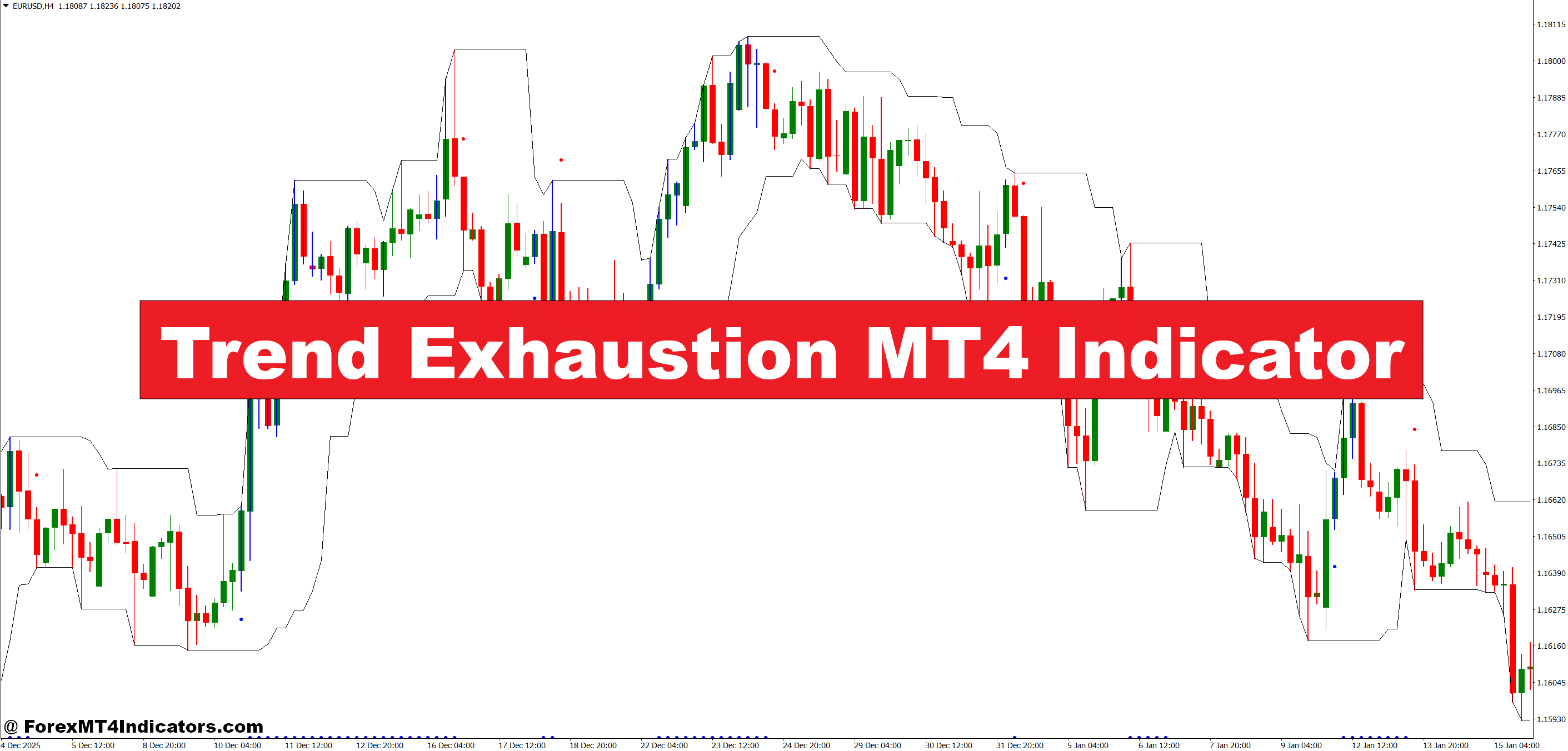
The Trend Exhaustion MT4 Indicator was designed to address that exact issue. It helps traders spot when buying or selling pressure is stretched and a pause or reversal is likely. Instead of reacting late, traders can prepare early. Before getting into the details, it helps to understand what this indicator really measures and how it fits into real trading decisions.
What the Trend Exhaustion MT4 Indicator Is
The Trend Exhaustion MT4 Indicator is a technical analysis tool that focuses on identifying when a market trend is nearing its end. Rather than following momentum blindly, it looks for conditions where price has moved too far, too fast, in one direction.
Unlike classic trend-following indicators, this tool sits closer to the “warning system” side. It doesn’t try to predict exact tops or bottoms. Instead, it highlights zones where probability shifts. When trends are mature, risk increases for continuation trades and improves for pullbacks or reversals.
Traders often compare it to oscillators like RSI or Stochastic. The difference is context. Trend exhaustion logic tracks consecutive price pushes and volatility expansion, not just overbought or oversold levels. That makes it more useful in strong trends where RSI can stay extreme for hours or days.
How the Indicator Works in Practice

At its core, the Trend Exhaustion MT4 Indicator analyzes price sequences and volatility behavior. Most versions count a series of bullish or bearish candles combined with range expansion. When price keeps closing higher without meaningful pullbacks, buying pressure may be peaking.
For example, on EUR/USD H1, price may print eight or nine strong bullish candles with increasing range. The indicator flags this as potential bullish exhaustion. That doesn’t mean price must reverse immediately. It suggests upside risk is rising while reward is shrinking.
Some versions also factor in average true range (ATR). When candles stretch well beyond recent ATR values, the move may be overextended. Experienced traders notice this manually, but the indicator makes it visible at a glance.
When testing this during volatile NFP sessions, traders often see exhaustion signals appear near session highs or lows. But smart traders wait for confirmation. A bearish engulfing candle or break of minor support adds structure to the signal.
Trading Applications and Real Examples
Here’s a common setup traders use. GBP/USD on the 15-minute chart trends down during London session. After a sharp 60-pip drop, the Trend Exhaustion MT4 Indicator prints a bearish exhaustion signal. Price stalls, then prints a bullish pin bar near intraday support.
Instead of buying blindly, traders wait for the next candle to close above the pin bar high. Stop loss goes 12–15 pips below support. Target is the 20–30 pip pullback toward the 20 EMA. The trade isn’t about catching the bottom. It’s about capturing a reasonable correction.
On higher timeframes, the indicator works differently. On USD/JPY H4, an exhaustion signal near a weekly resistance level often leads to multi-day pullbacks. Traders combine it with support and resistance to filter noise.
But here’s the thing. This indicator performs best as a filter, not a trigger. Using it alone leads to early entries. Pairing it with price action or structure keeps trades disciplined.
Trend Exhaustion MT4 Indicator Settings, Customization

Most Trend Exhaustion MT4 Indicator versions allow adjustment of sensitivity. Lower values react faster but produce more signals. Higher values are slower but cleaner. For scalping on M5 or M15, traders often reduce sensitivity slightly to catch short-term exhaustion.
On H1 and above, default settings usually work fine. Major pairs like EUR/USD and GBP/USD respond better than exotic pairs due to smoother price behavior. During low-liquidity Asian sessions, signals tend to be less reliable.
A practical tip many overlook is session context. Exhaustion signals during London-New York overlap carry more weight than those printed in quiet hours. And during strong news trends, it’s safer to wait for structure breaks before acting.
Advantages, Limitations, and Comparisons
One clear advantage of the Trend Exhaustion MT4 Indicator is timing awareness. It helps traders avoid late entries and recognize when patience pays. It also pairs well with trend-following tools by warning when to scale out.
That said, it has limits. In runaway trends, exhaustion signals can appear multiple times before price finally pulls back. Traders who counter-trend too aggressively can stack losses. That’s why confirmation matters.
Compared to RSI, this indicator handles strong trends better. RSI often stays above 70 or below 30 for long periods. Compared to MACD divergence, exhaustion signals appear earlier but with less precision. Each tool has a role. Many traders combine them for layered confirmation.
Trading forex carries substantial risk. No indicator guarantees profits. Market conditions change, and losses are part of the game.
How to Trade with Trend Exhaustion MT4 Indicator
Buy Entry

- Bullish exhaustion after a strong drop – When the indicator shows bearish exhaustion after a 40–80 pip decline on EUR/USD H1, wait for a bullish candle close to confirm sellers are losing control.
- Price reacts at support zone – Take buy setups only if exhaustion appears within 5–10 pips of a clear H1 or H4 support level to avoid random counter-trend trades.
- Confirmation candle closes bullish – Enter buy when the next candle closes bullish above the exhaustion signal, not during the signal candle itself, to reduce fake-outs.
- ATR-based stop loss placement – Place stop loss 1× to 1.5× ATR (usually 15–25 pips on H1) below the recent swing low to control downside risk.
- Partial profit at first pullback – Secure 30–40% of the position after 20–30 pips in profit, especially during London or New York sessions.
- Trend still intact on higher timeframe – Only buy if H4 or Daily structure shows higher lows; avoid buys against a strong daily downtrend.
- Momentum slows near session low – Buy signals near London or New York session lows tend to work better than signals during low-volume Asian hours.
Sell Entry

- Bearish exhaustion after extended rally – When price rallies 50–100 pips on GBP/USD H1 and the indicator flags bullish exhaustion, prepare for a short setup.
- Rejection from resistance level – Enter sells only if exhaustion forms within 5–15 pips of a marked resistance or prior swing high.
- Bearish candle confirmation – Open sell trades only after a bearish candle closes below the exhaustion signal to avoid early entries.
- Controlled stop above structure – Set stop loss 15–30 pips above resistance or 1× ATR above the signal candle to protect capital.
- Avoid strong news momentum – Do not sell if price is driven by high-impact news like NFP or CPI; exhaustion signals fail often in news spikes.
- Scale out near intraday support – Take partial profits at the nearest H1 support level, usually 25–40 pips away, to reduce exposure.
- Higher timeframe trend agrees – Best sell signals appear when H4 or Daily shows lower highs; skip trades against a strong bullish structure.
Conclusion
The Trend Exhaustion MT4 Indicator offers traders a structured way to judge when trends are running out of energy. It highlights overextended moves, helps avoid late entries, and improves trade timing when paired with price action.
Traders often find value in three areas: spotting pullback opportunities, managing exits in strong trends, and filtering low-quality continuation trades. It works best on liquid pairs and active sessions. But it isn’t a standalone system and won’t replace sound risk management.
Used with discipline, this indicator becomes a decision aid, not a signal machine. Traders who respect its limits and combine it with structure tend to get the most from it. The real edge comes from practice, not the tool itself.
Already an XM client but missing out on cashback? Open New Real Account and Enter this Partner Code: VIP90
Recommended MT4/MT5 Broker
XM Broker

(Free MT4 Indicators Download)

Enter Your Email Address below, download link will be sent to you.
Share
What's Your Reaction?
 Like
0
Like
0
 Dislike
0
Dislike
0
 Love
0
Love
0
 Funny
0
Funny
0
 Angry
0
Angry
0
 Sad
0
Sad
0
 Wow
0
Wow
0