
ThredUp’s CEO has a warning for five-day companies: You’re going to lose the talent war
A four-day workweek leaves employees more content and well-rested, and that directly translated to increased and sustained revenues.

Finding the perfect pair of jeans requires patience and a willingness to try things that don’t always fit. ThredUp has built an entire business around that idea, giving people a second shot at finding what works, and a guilt-free way to let go of what doesn’t.
And like a good pair of jeans, the same logic applies to making sure your employees are a good fit and are handled with care. That’s what James Reinhart thought when running the beloved secondhand resale company. When he saw what happened after he gave his employees a four-day work week—satisfaction, retention, and creativity all skyrocketed—he didn’t overthink it. A good fit makes the jeans worth hanging onto.
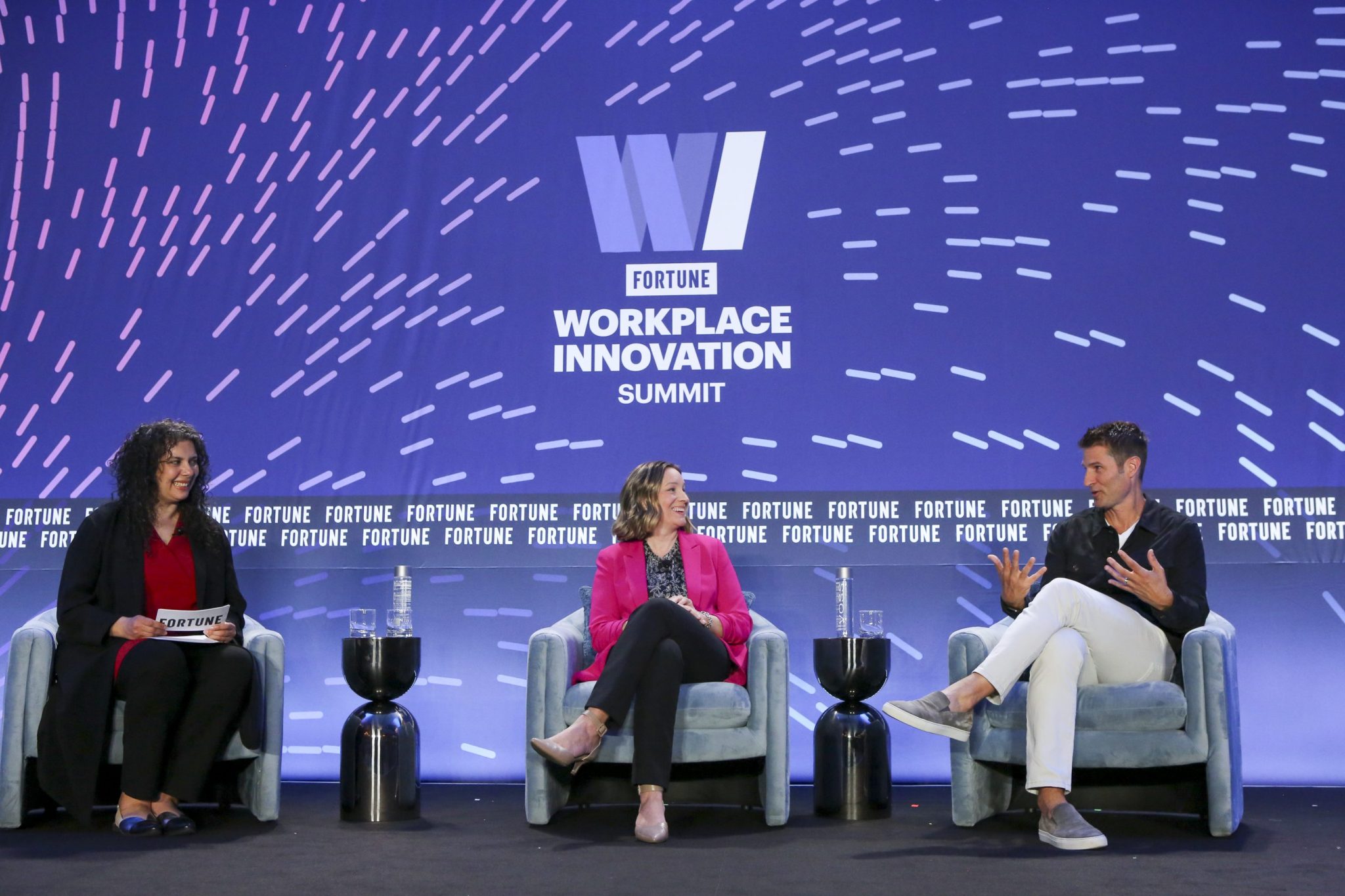
“It was a top-level decision,” the ThredUp co-founder and CEO said while making the case at Fortune’s Workplace Innovation Summit in Atlanta on Tuesday, speaking on a panel titled “Burnout Is Breaking Work” moderated by Fortune’s Indrani Sen. “We’re not going back.” And that’s why, Reinhart argues, his company will have a leading edge in attracting top talent while other companies still require a five-day workweek.
Reinhart introduced the four-day workweek during the pandemic after noticing that when employees had full control over their schedules, productivity exploded and, he said, typical retention metrics went “through the roof.” So, when companies answered calls to return to the office as the pandemic eased, Reinhart decided the four-day workweek would become a permanent fixture for the company.
Malissa Clark, a professor of psychology at the University of Georgia and author of “Never Not Working,” has data to back up Reinhart’s observations. She pointed to research conducted through the four-day workweek global movement—which was run in psychometrically rigorous trials across multiple companies—found all of a company’s fears about a four-day workweek may very well be unfounded.
“All of the well-being metrics were going up, burnout was going down, turnover was going down,” Clark said. “But companies always care about the bottom line, and this is the most exciting part: revenue went up in the majority of these companies, and it’s sustained over time.”
Most surprising, Clark said, was that 96% of employees in those trials said they wanted to continue with the four-day work week, and a whopping 15% said they would not return to a five-day schedule for any amount of money. “That I thought was shocking,” Clark told the crowd.
AI is bringing talent wars
Reinhart’s argument for the policy has evolved beyond ThredUp’s own numbers. In a world where AI is rapidly reshaping how work gets done, Reinhart believes the four-day week is the competitive edge in reaching exceptional talent, and companies still operating on a five-day model are at risk of falling behind.
“Those exceptional employees are going to want to work at ThredUp four days a week,” he said. “And you’re going to be competing against companies like mine for these exceptional people. And you’re going to lose.”
Part of that lure is how the employees themselves feel upon returning to the four-day workweek. “Rested employees and genuinely happy employees are way more creative,” Reinhart said. “When people come back on Monday morning, they’ve gone on hikes, they’ve spent time with their kids and families. They’re ready to be the best version of themselves.”
“They’re not going to spend the first four hours of Monday getting back in the groove and reminding themselves why they still want to work here.”
Clark agreed with Reinhart’s observations, but warned that the four-day workweek wasn’t so much as cramming a 40-hour week into four days as a genuine reduction to 32 hours, one that respected an employee’s life outside of work. “The bottom line with the four-day work week is shaving those eight hours off,” Clark said, agreeing with Reinhart’s point that happy employees are the more creative ones. “The best ideas sometimes come to me when I’m on my walk or in the shower,” she said. “Not when I’m working on something for six hours in a row.”
With that much-needed work-life balance and rest, Clark said, and with Reinhart’s predictions of AI reinventing the future of the workplace, Clark advocated for at least one net positive to come from AI’s prognostications.
“With every technological revolution, there are these predictions,” Clark said. “Can we please, for the love of God, implement those predictions, and at least shave off a day?”
This story was originally featured on Fortune.com
Share
What's Your Reaction?
 Like
0
Like
0
 Dislike
0
Dislike
0
 Love
0
Love
0
 Funny
0
Funny
0
 Angry
0
Angry
0
 Sad
0
Sad
0
 Wow
0
Wow
0